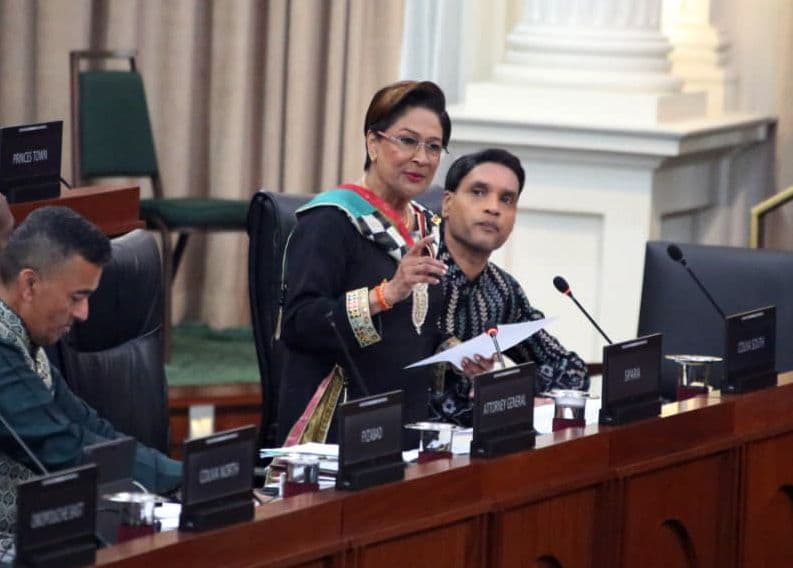
The United National Congress won the April 28, 2025 general election with 26 seats to the PNM's 13 and the TPP's 2, and Kamla Persad-Bissessar was sworn in as Prime Minister on May 1. One year later, there is enough data to evaluate what the government has done, what it inherited, and what it chose not to do. The record is mixed in ways that do not fit any single narrative. The UNC's strongest achievement - a 42 percent reduction in murders - was built on a tool the party once called a disgrace. Its weakest areas - jobs, growth, energy - reflect both inherited problems and new decisions that made them worse.
Crime: Real Gains, Real Questions
The murder count fell from 626 in 2024 to 369 in 2025 - a 42 percent decline and the lowest figure since 2014. That is a genuine result. The TTPS conducted 12,574 operations, seized 673 illegal firearms, and carried out over 82,000 searches. Whatever else can be said about the methods, the outcome was a measurable reduction in violent death. For the families of the roughly 257 people who were not murdered in 2025 compared to the prior year, method is an abstraction.
The method, however, matters for sustainability. Three States of Emergency were declared in the government's first year. Trinidad and Tobago spent approximately 72 percent of 2025 under emergency powers - warrantless searches, detention without bail, restrictions on movement and speech. When the UNC sat in opposition, it called the SoE "a shameless political gimmick." The same party then declared three in twelve months, a pace with no precedent in the country's history.
The Zones of Special Operations bill, which would have given police targeted powers with oversight provisions, was defeated in the Senate on January 27 when eight of nine Independent Senators voted against it, citing the absence of a sunset clause and the government's refusal to require body cameras. The PM responded by calling the senators "brown-nosers and bootlickers" and declaring a full SoE five weeks later - broader powers, less oversight, no Senate approval needed.
The early 2026 data raises harder questions. Q1 2026 is tracking 29 percent above Q1 2025 in murders. The SoE gap analysis published on this site examined what happened during the 30-day window between the second and third SoEs. The government has not published the data from that period. If emergency powers are the primary crime-reduction mechanism, the question is what happens when they end - and the early evidence is not encouraging.
The Home Invasion Act, passed 23-10, was one of the few legislative measures that addressed crime outside the SoE framework. It remains too early to assess its effect.
Economy: Flat Growth, Shifting Credit Outlook
GDP grew an estimated 0.8 percent in 2025. The IMF projects 0.7 percent for 2026. These are not recessionary numbers, but they are not growth either - they are stagnation dressed in decimal points.
The Budget Scorecard tracks the TT$59.2 billion budget the government presented. Its oil price peg of US$73.25 per barrel sits well above current market prices around US$60. The Heritage and Stabilisation Fund holds US$6.38 billion, a meaningful buffer, but both S&P and Moody's shifted their outlooks to negative during the year. A US$1 billion sovereign bond was 2.5 times oversubscribed - a sign of investor appetite, but also a signal that the government is borrowing. The National Investment Fund bond promised for Q2 2025 has not been issued.
The EU blacklist removal in February 2026 was a positive development, ending a designation that had complicated international banking relationships. It reflected regulatory changes that spanned both the PNM and UNC periods.
Energy: Inherited Pipeline, No New Starts
Every major energy project in the current pipeline traces to the PNM administration. Shell's Manatee reached final investment decision in July 2024. Ginger's FID came in March 2025, weeks before the election. Cypre delivered first gas on April 3, 2025 - before the UNC was sworn in. The Coconut development was advanced under the PNM. The ExxonMobil production-sharing contract was PNM-initiated.
Gas production sits at roughly 2.54 billion cubic feet per day, 33 percent below the 2015 peak. Atlantic LNG permanently decommissioned Train 1 in March 2025 for lack of feedstock. The downstream petrochemical sector continues to contract.
The Dragon gas saga is the most documented policy reversal of the year. On May 6, 2025 - five days after taking office - the PM declared Dragon "dead." By September, she reversed course. By October, the government was pursuing the same OFAC licence framework the PNM had established. Then Venezuela suspended its cooperation agreements. The project's current status depends on geopolitical variables that Trinidad and Tobago does not control, but the five-month flip-flop consumed time and credibility during a period when the country's gas supply was declining month over month.
The OWTU-UNC alliance adds a layer of complexity. Ancel Roget's union has a direct interest in the Guaracara refinery. Ernesto Kesar, the OWTU's executive vice-president, sits in the Energy Ministry overseeing energy policy while the union pursues its refinery contract. This is not illegal, but it is a governance arrangement that invites scrutiny.
Jobs: 16,000 Lost, 1,801 Hired
Between June and September 2025, the government eliminated CEPEP, URP, and the National Reforestation Programme, displacing an estimated 16,000 to 20,000 workers. The CSO recorded 12,000 job losses between April and September. The rationale - that these were patronage programmes producing little real work - had some basis. But the government's own replacement fell short. The National Recruitment Drive received 110,000 applications. As of late February 2026, 1,801 people had been hired, on three-month contracts.
The PSA secured a 10 percent wage increase. Non-aligned unions remain stuck at 4 percent. The gap raises questions about whether the wage settlement reflected fiscal calculation or political alliance.
Legislature and Cabinet
The government passed approximately seven substantive acts in its first year, including the Virtual Assets Act, the Home Invasion Act, and a THA Amendment. This is a thin legislative record for a government with a comfortable parliamentary majority.
The Cabinet numbers roughly 38 members, the largest in Trinidad and Tobago's history. At least three ministers carry unresolved legal questions. Minister Lee faces active fraud charges. Minister Moonilal is defendant in a $275 million lawsuit related to the EMBD. Minister Roberts remains associated with the LifeSport controversy. Gerald Ramdeen, whose corruption charges were discontinued after a witness refused to testify, was appointed Chairman of NGC - the state company negotiating the country's most important energy deal. Anand Ramlogan, whose own kickback charges were discontinued in the same proceeding, has been doing government legal work.
None of these appointments are illegal. All of them are choices. A government with 26 seats had options.
Foreign Policy: A Sharp Pivot
The UNC moved decisively toward Washington. The PM met Secretary Rubio, thanked President Trump twice at the UN General Assembly, and welcomed the USS Gravely to Trinidad and Tobago's waters. She declared the Caribbean "not a zone of peace" - a departure from decades of regional diplomatic language that prompted eleven former CARICOM prime ministers to issue a joint statement of concern.
The Venezuela relationship deteriorated in parallel. Caracas declared the PM persona non grata. The Dragon gas reversal did not help. Indian Prime Minister Modi visited in July 2025, expanding bilateral ties, though the tangible outcomes remain to be seen.
The Washington pivot is a strategic bet. It may pay dividends - OFAC licences, security cooperation, trade preferences. But it came at a cost to regional relationships that Trinidad and Tobago has maintained across administrations for decades, and it left the country exposed when Venezuela chose to retaliate.
The Sustainability Question
The strongest case for the UNC's first year is the murder reduction. It is real, it is significant, and no amount of criticism about method erases the fact that fewer Trinbagonians died violently in 2025 than in any year since 2014.
The strongest case against is that nearly everything else has stalled or regressed. Growth is flat. The energy pipeline was inherited, not built. The one major energy initiative the government could claim - Dragon - was first killed, then revived, then frozen by external forces. Sixteen thousand workers were fired and fewer than two thousand replaced. The legislative output is thin. The Cabinet is bloated. Key institutional appointments went to individuals whose legal histories would disqualify them in most comparable democracies.
And the murder reduction itself faces a sustainability problem. It was achieved primarily through emergency powers that the government's own party once rejected as unconstitutional overreach. Q1 2026 is already trending worse. If the only tool that works is one that suspends constitutional rights, and that tool produces diminishing returns, the government has not solved the problem. It has deferred it.
The Promise Tracker on this site will continue to measure specific commitments against outcomes. This review is a baseline. The second year will determine whether the UNC's first year was a foundation or a high-water mark.
Sources
- Trinidad and Tobago Police Service: 2025 crime statistics, operational data (12,574 operations, 673 firearms seized, 82,000+ searches)
- Central Statistical Office: Employment data, April-September 2025 (12,000 job losses)
- Ministry of Finance: Budget 2025/2026, TT$59.2 billion; Heritage and Stabilisation Fund balance
- IMF: World Economic Outlook, Trinidad and Tobago GDP projections (0.8% 2025, 0.7% 2026)
- S&P Global Ratings and Moody's: Credit outlook shifts to negative (2025)
- Trinidad Express: SoE extension coverage, Senate ZOSO vote (January 27, 2026), Q1 2026 murder data
- Trinidad Guardian: Dragon gas timeline, OFAC licence reporting, NRD hiring figures
- Hansard: Home Invasion Act vote (23-10), SoE extension vote (26-12)
- CARICOM: Joint statement by eleven former prime ministers on "zone of peace" declaration
- EmployTT: National Recruitment Drive data (110,000 applications, 1,801 hired as of February 2026)
- Reuters/Stabroek News: Shell-Venezuela agreements, March 2026
- OFAC: Venezuela-related General Licenses 49 and 50 (February 2026)
- Shell: Manatee FID (July 2024); bpTT: Ginger FID (March 2025)
- Shell Trinidad: Cypre first gas (April 3, 2025)
- EU Council: Blacklist removal, February 2026