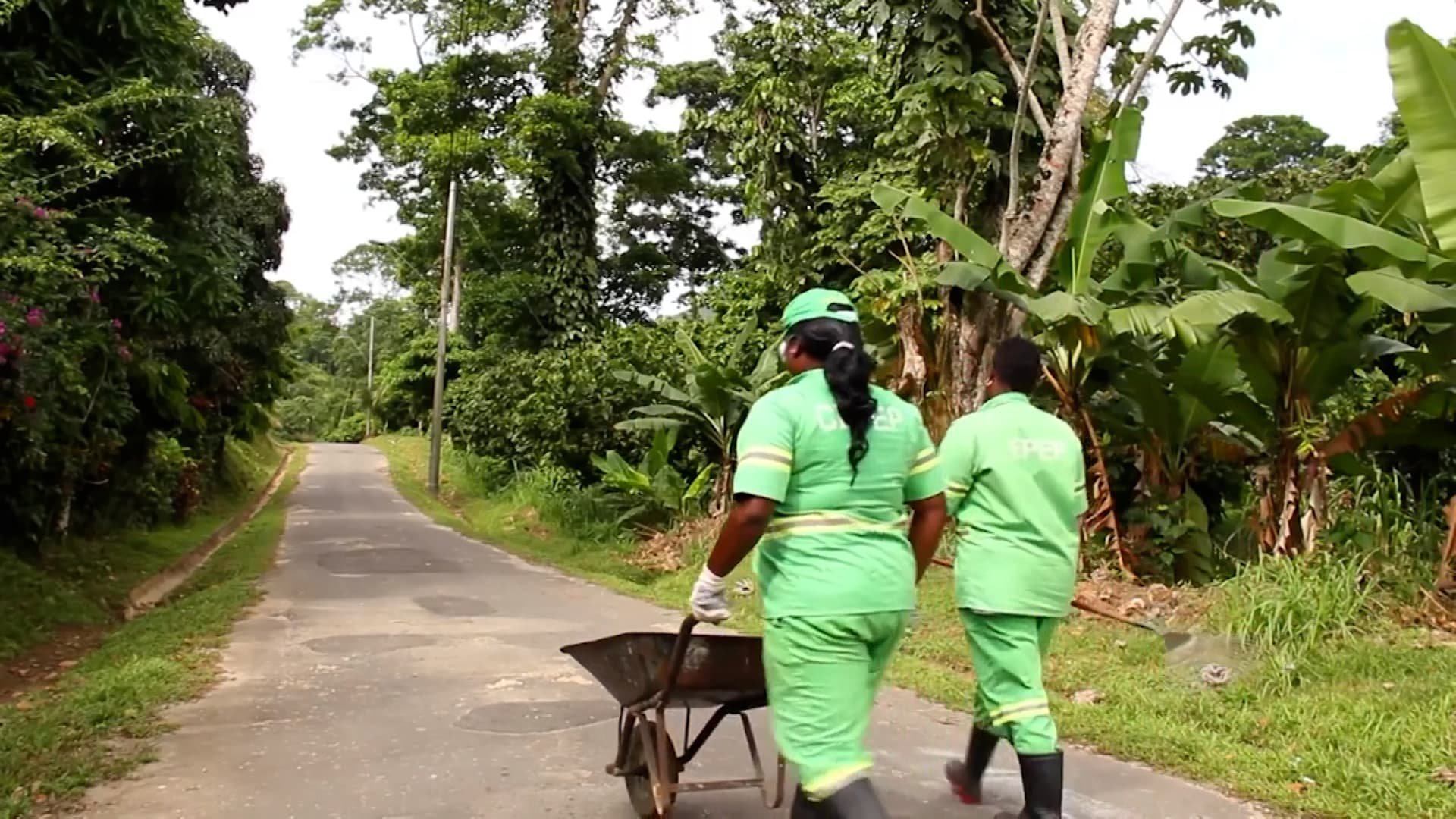
Visham Maharaj worked in CEPEP for 25 years. He cut grass, cleaned drains, and cleared brush across communities that the municipal corporations did not reach with their own staff. He earned approximately $103.50 per day. He has a child with cerebral palsy. When his termination letter arrived on June 27, 2025, citing Clause 15.1 of the 2022 contract, his first thought was that he might lose his home. Twenty-five years of roadside labour, and the state gave him a form letter.
Eastlyn Bomant, 60, received the same letter. She told reporters months later: "I still cry to this day."
These are the people who were described as collateral damage - a phrase used by Dr. Kirk Meighoo, a political economist, in a radio interview after the terminations. Not victims. Not casualties. Collateral damage. The language says everything about how the programmes were viewed by those who dismantled them - and how little thought was given to who would fill the gap.
The Programmes and What They Actually Did
CEPEP - the Community-based Environmental Protection and Enhancement Programme - employed approximately 10,500 workers under 330 to 360 contractors nationwide. The work was unglamorous and physically demanding: drainage clearing, roadside vegetation maintenance, mosquito spraying, dead animal removal, minor repairs to public spaces. The workers were overwhelmingly from low-income communities. Many had no other formal employment history. They earned $103.50 per day on rolling short-term contracts.
URP - the Unemployment Relief Programme - did much the same thing, employing daily-paid and monthly-paid workers on infrastructure maintenance and community projects. Both programmes had been running for decades, surviving every change of government because every government found them useful - as employment, as community maintenance, as patronage.
The National Reforestation and Watershed Rehabilitation Programme added 4,608 workers focused on environmental conservation, replanting, and watershed management. All three programmes worked the same way: low-paid workers doing physical labour that municipalities either could not or would not handle through permanent staff.
Were these programmes riddled with problems? Undeniably. URP manager Feeroz Khan said 8,000 ghost workers had been removed from the payroll, and only about 20% of registered names actually showed up to work on any given day. CEPEP contractors were widely understood to distribute work along political lines, and both the PNM and UNC used the programmes to reward supporters when in power. The last-minute renewal of over 360 CEPEP contracts between April 14 and 24, 2025 - the final days before the general election - without Cabinet approval was a textbook example of the patronage problem.
None of this was new information. Every government since these programmes started knew about the inefficiencies. None chose to fix the structure. They just swapped in their own people.
The Terminations
The government moved in three waves. On June 27, 2025, all CEPEP workers and contractors received termination notices. On July 2, the National Reforestation Programme was shut down, displacing 4,608 workers. On September 10, URP workers were terminated with immediate effect - 400 of the 1,100 monthly-paid workers dismissed outright, the daily-paid component suspended entirely.
The Central Statistical Office recorded 12,000 job losses between April and September 2025. The actual number of individuals affected was higher, because many workers held positions in overlapping programmes or lost supplementary income when contractors folded.
The government's line was simple: the programmes were wasteful, politically corrupted, and would be replaced with something better. The replacement was the National Recruitment Drive, which promised 20,000 permanent positions. Over 110,000 Trinbagonians applied. By late February 2026, 1,801 had been hired - on three-month contracts, doing the same kind of work CEPEP had been doing, but with late pay.
220 Workers for an Entire Country
The number that tells this story best is not 16,000 or 1,801. It is 220.
That is the total number of workers deployed nationally across the 14 municipal corporations to replace the work formerly done by CEPEP and URP crews. Two hundred and twenty people were expected to maintain drainage, cut vegetation, remove debris, and manage public spaces across every city, borough, and regional corporation in Trinidad.
In Port of Spain, where over 500 CEPEP and URP workers had been cleaning drains and maintaining public spaces, the replacement was 12 staff from a new "National Programme for the Upkeep of Public Spaces." Mayor Chinua Alleyne warned of a sanitation crisis ahead of Carnival 2026. He was not exaggerating. Five hundred workers replaced by twelve means one new worker for every 42 terminated.
In Tunapuna-Piarco, where roughly 450 workers had been deployed, the corporation received 24 replacements. The workers arrived without tools.
Without tools.
The math is not complicated. If 16,000 workers were doing the physical maintenance of public spaces across Trinidad, and 220 replaced them, the coverage dropped by over 98%. The drains that those workers cleaned did not disappear. The grass they cut did not stop growing. The dead animals they collected did not stop dying. The work still exists. The workers do not.
The $475 Million Nobody Can Account For
The 2026 budget established a $475 million Employment Fund to support the transition from CEPEP and URP to permanent employment. When Finance Minister Davendranath Tancoo was asked in Parliament how much of the fund had been disbursed, he said he did not have that information at his disposal.
The Employment Fund was meant to finance the recruitment drive. The 1,801 workers hired by the Ministry of Works and Infrastructure are paid from it. An additional 800 were expected from March 2026. But $475 million divided by 20,000 workers yields roughly $2,000 per month per person - below minimum wage and barely enough to cover a single year of employment even at that rate.
The opposition calculated the same arithmetic. The government's response was that $475 million was an "initial sum." No follow-up allocation has been announced.
Meanwhile, 1,801 workers were eventually hired on three-month contracts doing what the government had called make-work when CEPEP did it. The distinction between the old programme and the new one - aside from the late payments and the reduced headcount - has not been made clear by anyone in a position to explain it.
The Tobago Exception
One detail makes the rest of the story harder to defend on purely fiscal or structural grounds: CEPEP and URP continue to operate in Tobago. The Tobago House of Assembly allocated $27.2 million to both programmes in its 2026 budget. No reduction. No restructuring. No terminations.
The government has not publicly explained why the same programmes that were deemed wasteful and politically corrupted in Trinidad remain funded and operational in Tobago. If the rationale for termination was that the programmes did not work, then Tobago should have faced the same reform. If the rationale was that the programmes were tools of PNM patronage, then their continuation in Tobago - where the THA is controlled by the TPP, whose two parliamentary MPs sit on the UNC's government benches - contradicts the logic entirely.
The exception suggests that the decision to terminate was not purely about efficiency or governance. It was about politics and about who the government believed it could afford to cut loose without electoral consequences. Tobago was exempted. Trinidad was not.
The People in Between
The human cost sits somewhere between the policy debate and the fiscal spreadsheet, and nobody in either conversation seems to be looking at it. Visham Maharaj, with his 25 years of service and his child who needs care he cannot afford without steady income, is not an abstraction. Neither is Eastlyn Bomant, who at 60 has no realistic prospect of re-entering the formal labour market.
The jobs did not pay well. They came with no pensions, no benefits, no career ladder. But they were consistent. They paid every fortnight. They gave workers a reason to leave the house, a place in the community's maintenance, and a small amount of financial predictability in a country where that is increasingly rare.
The government framed the terminations as the end of patronage. What it delivered was the end of income for 16,000 people without a functioning replacement. The Promise Tracker records the commitment. The Budget Scorecard tracks the money. The Manifesto examination checks the broader pledge. But none of those documents capture what it feels like to receive a termination letter after 25 years and then watch the grass grow back over the drains you used to clean - knowing that nobody is coming to replace you.
The drains are still there. The workers are not. And the 220 people sent to fill a 16,000-person gap arrived, in at least one corporation, without so much as a cutlass.
Sources
- Trinidad Guardian: "500 PoS workers sent home; mayor warns of sanitation crisis" (2025)
- Trinidad Guardian: "National Recruitment Drive falls short: 20,000 jobs promised, 1,801 people hired" (February 2026)
- Trinidad Guardian: "THA spending $27.2M on CEPEP and URP in Tobago" (2025)
- Trinidad Guardian: "CEPEP contracts renewed days before election without Cabinet approval" (2025)
- Trinidad Express: "10,500 CEPEP workers terminated" (June 2025)
- Trinidad Express: "URP workers terminated with immediate effect" (September 2025)
- Trinidad Express: "National Reforestation Programme shut down - 4,608 workers affected" (July 2025)
- Newsday: "Only 20% of URP registered names showed up for work" (2025)
- Newsday: "Tancoo: $475M to help fund 20,000 new jobs" (October 2025)
- CNC3: "EmployTT recruitment drive - 30,000 apply in 24 hours" (October 2025)
- CNC3: "Former CEPEP workers speak out" (2025)
- CSO: Labour Force Statistics, April-September 2025
- Ministry of Works and Infrastructure: Recruitment drive screening documentation (November 2025)
- Tunapuna-Piarco Regional Corporation: Municipal maintenance staffing reports (2025-2026)