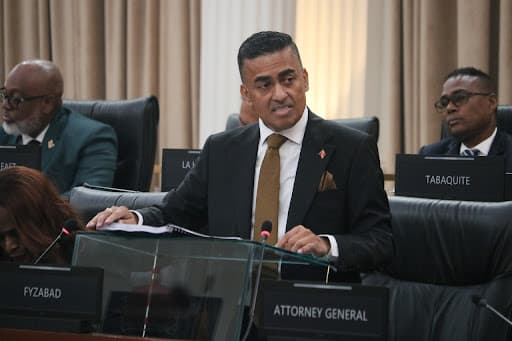
Davendranath Tancoo read Trinidad and Tobago's 2026 budget on October 13, 2025. It was a $59.2 billion document built on oil at US$73.25 per barrel and gas at US$4.25 per MMBtu, projecting a deficit of $3.865 billion - a number the IMF would later calculate at more than double that figure. Six months in, the oil price peg sits roughly $12 above market reality, both international rating agencies have shifted the country's outlook to negative, and the Heritage and Stabilisation Fund has seen $2.8 billion in withdrawals without a single deposit.
What follows is not about who Tancoo is. It is about what happened after he took the finance portfolio - and what the numbers say when you check them against public data.
The NIF Bond Math
The budget's most specific financial instrument was the National Investment Fund bond - a $1 billion (TT) bond backed by the government's shareholding in First Citizens Bank. Tancoo described the asset backing as worth approximately $2 billion in his budget presentation. The figure would later become the clearest example of a gap between what was said in Parliament and what the arithmetic supports.
The Guardian checked the numbers. The government holds approximately 31.7 million First Citizens shares. At the time of the budget, First Citizens traded at $34.99 per share. That is approximately $1.11 billion - not $2 billion. The gap is roughly $890 million.
The gap matters. A $1 billion bond backed by $1.11 billion in shares has almost no margin. If the share price drops by even 10 percent, the collateral falls below the face value of the instrument. For institutional investors assessing the bond's risk, the difference between $2 billion in backing and $1.11 billion in backing is the difference between a well-collateralised instrument and a tight one.
The bond's Q2 issuance deadline - March 31, 2026 - passed without issuance. No new timeline has been announced. Whether the math contributed to the delay, or whether other factors intervened, has not been explained.
The Oil Price Peg
No finance minister can predict where oil will trade twelve months into a fiscal year. But the gap between the budget's assumed price and reality is not marginal variance. It is a structural problem.
The budget assumed WTI crude at US$73.25 per barrel. As of early April 2026, WTI is trading around US$60 to $62. That is a shortfall of roughly US$12 per barrel - a 16 percent miss on the budget's most important revenue input.
Energy revenues were projected at $11.254 billion. Every dollar below the assumed price erodes that figure. At current prices, the shortfall runs into the billions of TT dollars. This follows a prior fiscal year in which energy revenues fell by 48.4 percent.
The budget offered no hedging strategy and no contingency revenue scenario. It did not publish a sensitivity analysis showing what happens to the deficit if oil averaged $65, or $60, or $55. The $73.25 peg was presented as a single-point assumption without a downside plan.
Former finance ministers have also pegged budgets to optimistic oil prices. This is not unique to Tancoo. But the current gap between assumption and reality, combined with the IMF's deficit estimate of 5.0 percent of GDP against the government's own figure of 2.2 percent, suggests the budget was built on a foundation that the market has since removed.
The Rating Agencies
Two data points sit outside the government's control but directly reflect market confidence in its fiscal management.
Standard and Poor's shifted Trinidad and Tobago's outlook to negative in September 2025 - before the budget was even read. Moody's followed in December 2025, after reviewing the budget. Neither agency downgraded the credit rating outright, but a negative outlook is one step short and signals to international investors that conditions are deteriorating.
Both agencies, independently, reached similar conclusions: fiscal vulnerabilities, declining energy revenues, questionable revenue assumptions. The numbers are moving in the wrong direction.
For a country that successfully placed a US$1 billion international bond in 2025 - oversubscribed 2.5 times - the negative outlooks represent a shift in sentiment that could raise borrowing costs on future issuances. The bond was a genuine success for the government. The question is whether that success was a reflection of fiscal confidence or a window that is now closing.
What He Got Right
Any honest look at the record has to include where Tancoo has delivered.
The US$1 billion international bond, placed in the second half of 2025, was oversubscribed 2.5 times. For a small Caribbean economy, placing a billion-dollar sovereign bond at that level of demand is not trivial.
Trinidad and Tobago was removed from the EU tax blacklist on February 17, 2026, after legislative reforms including a new Special Economic Zone framework that replaced the old Free Trade Zone regime. The FATF compliance improvements followed a similar trajectory. Both required coordination across multiple agencies and legislative bodies, and both got done.
The 10 percent public-sector wage agreement, signed December 2, 2025, resolved back pay stretching over a decade. The PSA deal was concluded faster than most observers expected. Whether the $3.8 billion in back pay has been budgeted is a separate question - and a serious one - but the speed of the agreement was a political accomplishment.
These are not small things. They are the items a finance minister would rightly highlight in his own defence.
The Comparison He Cannot Escape
The finance portfolio in Trinidad and Tobago has historically gone to people with deep financial sector experience. No law requires it. But the convention exists because the job demands technical fluency that voters and markets both notice.
Larry Howai, who held the portfolio under the UNC from 2012 to 2015, was the CEO of First Citizens Bank. Winston Dookeran, who preceded him, was a former Governor of the Central Bank of Trinidad and Tobago. Karen Nunez-Tesheira, under the PNM, had been a banker. Conrad Enill held senior corporate finance roles. Gerald Yetming spent 36 years at RBTT Financial Group.
Tancoo's background is different. He holds a BA in Economics from UWI, an MBA from Anglia Ruskin University, an LLB from the University of London, and an LPC from Staffordshire University. His career, however, has been almost entirely political: Chief Economist in the Office of the Opposition Leader, Special Adviser to the Prime Minister on Finance from 2010 to 2015, and UNC General Secretary and Chairman.
Those roles are not nothing. Political advisers shape policy. Party officials run large organisations with real budgets. But they are different from running a bank or navigating international capital markets - the kind of experience a finance minister draws on when placing sovereign bonds and sitting across the table from the IMF.
Tancoo is not unqualified in some absolute sense. He has degrees, experience in government, and clearly the confidence of the Prime Minister. But his predecessors brought a type of technical credibility that markets and rating agencies respond to - and the current record, measured in missed pegs, disputed valuations, and negative outlook shifts, does not yet demonstrate that same credibility.
The Heritage and Stabilisation Fund
The HSF stood at a record US$6.34 billion as of September 2025. The fund was created for exactly this kind of moment - falling energy prices, rising deficits, fiscal stress. It is the country's rainy-day reserve.
In fiscal 2025, the government made zero contributions to the fund while withdrawing US$410 million. Total withdrawals reached US$2.8 billion. The Auditor General called for amendments to the HSF Act to provide greater clarity on the deposit mechanism - a polite way of saying the rules governing when the government must put money in are not being enforced.
A stabilisation fund that only sees withdrawals is not stabilising anything. It is financing current spending from savings. At the current rate, the balance declines each year, and the buffer available for genuine economic shocks shrinks with it.
Tancoo has not published a plan for replenishment. No target balance, no withdrawal ceiling.
Where This Leaves the Country
The IMF's February 2026 Article IV assessment projected a deficit of 5.0 percent of GDP - more than double the government's official 2.2 percent figure. Central government debt stands at 67.8 percent of GDP. Total public sector debt reaches 84.2 percent. GDP growth is projected at 0.7 percent.
These numbers do not describe a crisis. They describe a trajectory - and the distinction matters, because a crisis forces action while a trajectory allows delay. Delay is always politically easier than adjustment.
The Budget Scorecard, the Mid-Year Review, and the Promise Tracker form a record that will either vindicate the government's revenue assumptions or confirm what the rating agencies and the IMF are already signalling: that the numbers, as presented, do not add up. The second half of fiscal 2026 will determine which version is closer to the truth.
The oil price will not move because the finance minister wishes it higher. The deficit will not shrink because the budget says so. And a $1.1 billion asset does not become $2 billion because it is described that way in Parliament.
Numbers are stubborn that way.
Sources
- Ministry of Finance: Budget Statement 2026 - "T&T First" (October 13, 2025)
- Trinidad Guardian: "NIF bond math: shares worth $1.11B, not $2B as claimed" (2025)
- Trinidad Guardian: "NIF bond deadline passes without issuance" (March 2026)
- Trinidad Guardian: "S&P shifts T&T outlook to negative" (September 2025)
- Trinidad Guardian: "Moody's shifts T&T outlook to negative" (December 2025)
- Trinidad Guardian: "US$1B bond 2.5 times oversubscribed" (2025)
- IMF: Article IV Mission Concluding Statement - Trinidad and Tobago (February 10, 2026)
- Trinidad Express: "$2.8B withdrawn from HSF in 2025" (2025)
- Trinidad Express: "Tancoo: No information on Employment Fund disbursement" (2026)
- EU Council: "Taxation: Council updates the EU list" (February 17, 2026)
- Trinidad Guardian: "$3.8B back pay for public servants" (December 2025)
- Auditor General of Trinidad and Tobago: Report on HSF Act compliance (2025)
- Central Bank of Trinidad and Tobago: Heritage and Stabilisation Fund Quarterly Reports
- First Citizens Bank: Share price and volume data (October 2025)
- UWI: Alumni records; Anglia Ruskin University: Degree verification
- Parliament of Trinidad and Tobago: Budget Debate Hansard (October 2025)