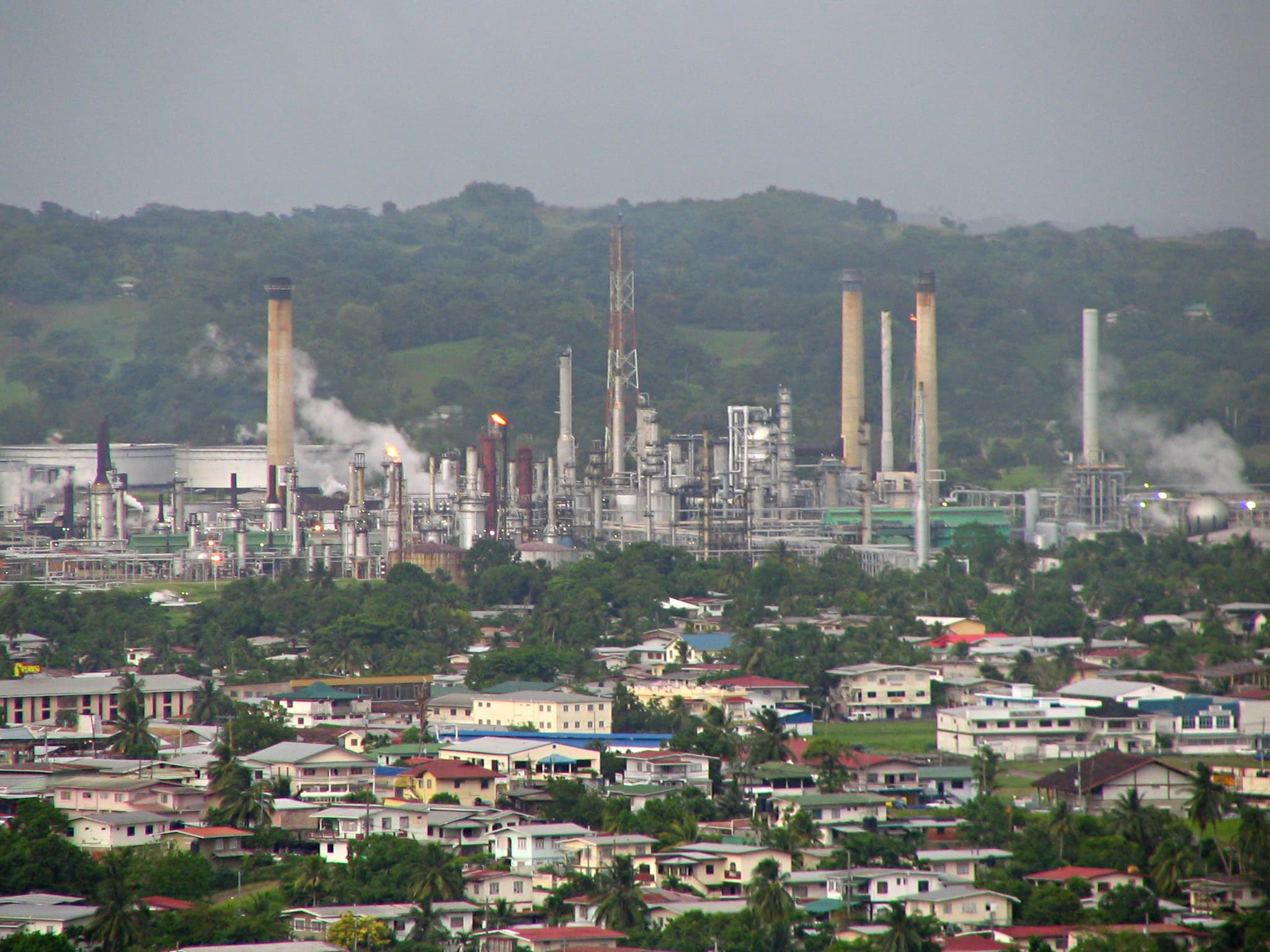
On October 23, 2025, Nutrien Ltd - one of the world's largest fertiliser producers and the operator of four ammonia plants and one urea plant at Point Lisas - began a controlled shutdown of its Trinidad Nitrogen operations. On January 1, 2026, the National Gas Company formally cut supply by isolating all gas meter runs to Nutrien's facility. The valves are fully shut. What had been one of Point Lisas's largest operations, accounting for 31% of Trinidad and Tobago's ammonia production and representing more than a quarter of Nutrien's global nameplate ammonia capacity, is now idle.
The production loss is approximately 85,000 metric tonnes of ammonia per month and 55,000 metric tonnes of urea - a shortfall of over 1.2 million metric tonnes annually. Over 500 workers face termination, with the Newsday reporting that indirect and contractor jobs bring the at-risk figure closer to 1,600. Nutrien had 750 employees total and had operated at Point Lisas since 1998. The Energy Chamber called the shutdown "a massive blow to the economy."
The Port Fee Dispute
The immediate trigger was a dispute over retroactive port fees totalling US$28 million (TT$190 million). The fees were imposed by the National Energy Corporation - an NGC subsidiary that manages the port infrastructure at Point Lisas - and dated back to January 2021. Nutrien's port contract had expired in 2019. The company's position was that it paid all invoices actually issued to it and that the retroactive claim was illegitimate. Nutrien demanded the US$28 million be withdrawn as a precondition to any negotiation.
NGC gave Nutrien until December 31, 2025, to submit a counter-proposal. Failure to respond would be treated as confirmation that Nutrien "no longer wished to operate in Trinidad and Tobago." Nutrien did not submit a proposal. NGC shut the gas off the next day.
NGC Chairman Gerald Ramdeen accused Nutrien of holding Trinidad and Tobago "to ransom." Ramdeen's own background is relevant context. A former UNC Senator, he was jointly charged in May 2019 alongside former Attorney General Anand Ramlogan in a corruption scheme involving more than TT$1 billion in legal fee kickbacks from British KC Vincent Nelson. The charges included conspiracy to contravene the Prevention of Corruption Act, conspiracy to contravene the Proceeds of Crime Act, and conspiracy to misbehave in public office. The DPP discontinued the charges in October 2022. Ramdeen was subsequently appointed NGC Chairman by Energy Minister Roodal Moonilal. Former Energy Minister Stuart Young accused Ramdeen of "destroying the energy sector through incompetence" and blamed UNC-appointed boards for creating an adversarial relationship with the downstream operators that generate the country's petrochemical export revenue.
Moonilal's own position deserves a closer look. The Energy Minister faces a $275 million civil cartel lawsuit - the EMBD case - heading to trial in June 2026. He approved a Heritage Petroleum Lease Operatorship Agreement to TN Ramnauth and Co. Ltd, which is his co-defendant in that same cartel lawsuit. Young had refused to approve TN Ramnauth's application for over three years specifically because the company was a subject of the EMBD litigation. The individuals directing NGC's negotiation strategy with Point Lisas operators carry unresolved legal and governance questions of their own.
Nutrien CEO Ken Seitz told analysts the company was "certainly not prognosticating" a shutdown extending into 2026 and would continue to engage with stakeholders. As of late March, engagement has not produced a resolution.
The Gas Price Shock
The port fee dispute was only part of the problem. On December 24, 2025 - Christmas Eve - NGC communicated to light industrial customers that gas prices would increase from approximately US$3 per MMBtu to US$5.30, a rise of roughly 77%. The increase was described as non-negotiable.
NGC's justification is that industrial users have benefited from subsidised gas for decades, sometimes at prices below NGC's own acquisition cost. New upstream agreements come at higher prices, and NGC argues it can no longer absorb the difference. The argument has a factual basis. But delivering a non-negotiable 77% price increase on Christmas Eve, while simultaneously imposing retroactive port fees and cutting off gas supply to a major operator, is not a commercial negotiation. It is a signal that the operating environment at Point Lisas has become unpredictable.
The Energy Chamber's Q1 2026 survey found that 60% of energy services companies reported lower business value and 56% reported below-typical volume. The sector is contracting at a moment when the government's fiscal projections depend on it expanding.
Point Lisas Is Unravelling
Nutrien is not the only operator in trouble. The damage runs across the industrial estate.
Methanex, the world's largest methanol producer, has its Atlas plant - a 1,085,000 tonne-per-year facility in which it holds a 63.1% interest - idle since September 2024 after its gas agreement expired. Its wholly owned Titan plant has gas supply secured until September 2026, but the new pricing will reduce annual adjusted EBITDA by approximately $80 million and free cash flow by $40 million. Talks with NGC for renewal are ongoing, but the Atlas plant sits empty.
Proman has shut three of its five methanol plants. The M4 and M5000 plants, with a combined capacity of 2.47 million metric tonnes per year, shut down after NGC failed to renew their gas contracts at an acceptable price. Proman also closed its melamine plant for an initial two-year period, citing unfavourable global conditions and 154.28% in US anti-dumping and countervailing duties imposed in January 2025.
On the positive side, NGC recently signed a new gas sales contract with Point Lisas Nitrogen Ltd - a Koch-majority-owned operator - calling it a "significant milestone." Whether that deal signals a broader stabilisation or just an exception depends on whether similar contracts follow.
The CO2 Problem Nobody Planned For
Carbon dioxide is a byproduct of ammonia production. Trinidad and Tobago does not have a standalone CO2 production facility. When Nutrien shut down, Massy Gas - the principal local CO2 supplier - suspended all CO2 products. Hospitals use CO2 in certain medical procedures. The food and beverage industry depends on it for carbonation and preservation. Both lost supply overnight.
NGC subsequently secured alternative CO2 supply through Proman and Plipdeco at the same pricing Nutrien had charged. The immediate crisis was contained, but the episode showed that no one in the policymaking chain had apparently planned for an obvious risk: the country's medical and food-grade CO2 supply was entirely dependent on a commercial ammonia operation that could be shut down by a contract dispute.
A Declining Sector at the Worst Moment
Trinidad and Tobago's natural gas production peaked at 4 billion cubic feet per day in 2010. Current production stands at approximately 2.6 Bcf/d - a decline of more than one-third. In Q1 2025, gas production fell a further 5.9% year-on-year. The energy sector contracted 4.8%.
The Middle East conflict, which escalated in late February 2026, has driven commodity prices sharply higher - urea from US$482 to US$720 per tonne, ammonia from US$495 to US$600. Trinidad and Tobago cannot take advantage. It has spare LNG capacity but insufficient feedstock gas to fill it. The ammonia plants that could benefit from higher prices are either idle or operating below capacity.
The turnaround, if it comes, depends on 2027, when several large gas projects - Shell's Manatee, Aphrodite, Ginger, and Coconut - are expected to begin production. If delivered on schedule, they could restore output levels and strengthen LNG and petrochemical exports. But 2026 is a bridge year, and the bridge is missing planks. The fiscal position depends on revenue that the energy sector is not generating, from plants that NGC's own contract strategy is shutting down.
What the Shutdown Costs
Point Lisas is not a single factory. It is an industrial ecosystem where gas enters at one end and ammonia, methanol, urea, and other petrochemical products emerge at the other. The plants are interconnected through gas supply agreements, shared infrastructure, and overlapping supply chains. In 2024, eleven ammonia facilities produced just over 4 million metric tonnes, with Proman accounting for 38% and Nutrien 31%. With Nutrien offline and Proman's methanol plants shut, nearly half the estate's production capacity is affected.
When major operators shut down, the effects compound. Nutrien's closure removes a significant buyer of NGC's gas - which means less revenue for NGC, which means less revenue for the government, which owns NGC. The workers who lose their jobs spend less in surrounding communities. The contractors who serviced the plants lose that business. The foreign exchange from ammonia exports stops flowing into the banking system at exactly the moment when the forex shortage is already acute.
The promised resolution discussions between NGC and Nutrien have not produced a public outcome. The workers waiting for severance and redeployment have not received a timeline. And the question of whether this dispute was justified enforcement of contractual obligations or a governance failure that cost the country a major employer, a third of its ammonia production, and a critical source of foreign exchange remains the central issue nobody in authority has answered.
Sources
- Nutrien Ltd: Press release - "Nutrien commences a controlled shut down of its Trinidad Nitrogen operations" (October 21, 2025)
- Trinidad Express: "Nutrien confirms shutdown, US$28 million fee not waived" (2025)
- Trinidad Express: "NGC secures alternative CO2 supply" (October 2025)
- Trinidad Express: "The truth behind the 70% gas price increase" (2025)
- Trinidad Express: "Energy Chamber: Nutrien shutdown massive blow to economy" (2025)
- Trinidad Express: "NGC signs gas supply contract with PLNL to secure ammonia production" (2026)
- Trinidad Guardian: "NGC pulls plug on Nutrien - state gas company ends supply contract" (January 2026)
- Trinidad Guardian: "Nutrien holds its hand on terminating workers" (2025)
- Trinidad Guardian: "Young warns of economic fallout from NGC's Nutrien shutdown" (2025)
- Trinidad Guardian: "Is NGC telling T&T the whole truth?" (2026)
- Newsday: "Nutrien shutdown puts 1,600 jobs at risk" (October 2025)
- Newsday: "NGC on shutdown: Nutrien held T&T to ransom" (January 2026)
- Newsday: "NGC finds alternative CO2 for beverages amid Nutrien shutdown" (October 2025)
- Farm Progress: "Trinidad shutdown could push ammonia price" (2025)
- BNN Bloomberg: "Nutrien begins shutting down Trinidad Nitrogen operations" (October 2025)
- ChemAnalyst: "Nutrien shuts down Trinidad Nitrogen operations amid gas supply and port disputes" (2025)
- The 197 Initiative: Analysis of the Nutrien shutdown (2025)
- Methanex Corporation: Update on Trinidad and Tobago operations (2024-2025)
- Energy Chamber of Trinidad and Tobago: Ammonia production and export analysis
- Energy Now: "What MHTL plant closures mean for T&T energy"
- Trinidad Express: "Proman shuts melamine plant at Point Lisas" (2025)
- Hydrocarbon Processing: "Fight over port charges jeopardizes ammonia, methanol exports" (2025)
- S&P Global: "Arresting the decline - Trinidad and Tobago's natural gas supply alternatives"
- Caribbean Council: "Trinidad and Tobago set for 2027 gas production surge"