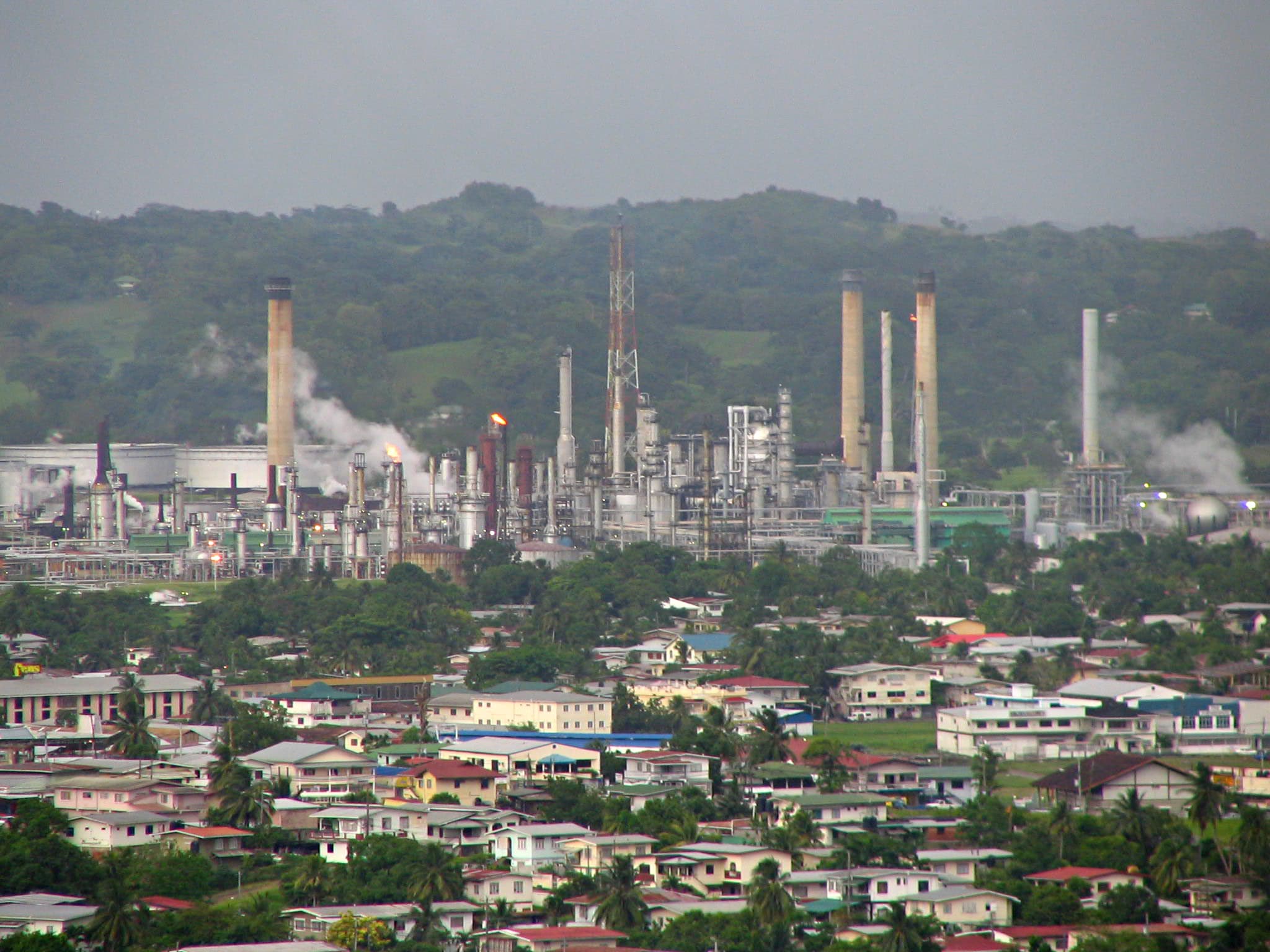
On March 25, 2026, Italian engineering firm MAIRE announced that its subsidiary Tecnimont Services had been awarded a US$50 million contract to study the rehabilitation of the Guaracara Refinery Complex in Pointe-a-Pierre. The announcement appeared on MAIRE's corporate website, confirmed within hours by Oil & Gas Journal, Hydrocarbon Processing, and BNamericas.
The Government of Trinidad and Tobago made no announcement. Kevin Ramnarine, chairman of the government's own Refinery Restart Committee, told reporters he had "no information on the Technimont story." And the company listed as Tecnimont's local partner is not the one most Trinbagonians have heard of.
This is a story about a US$50 million commitment that surfaced without warning, attached to a company that carries none of the debts of its predecessor, financed by people who refuse to identify themselves, for a refinery that has sat idle for nearly eight years.
Eight Years of Mothballs
The Guaracara Refinery - formerly the Petrotrin refinery - ceased operations in October 2018 when the Keith Rowley government restructured the state oil company. Petrotrin was broken into Heritage Petroleum, Paria Fuel Trading, and Guaracara Refining Company. The restructuring retrenched 4,700 workers, many of them OWTU members.
Since closure, the OWTU, led by president Ancel Roget, mounted three bids through its corporate vehicle Patriotic Energies and Technologies between 2019 and 2021. All three failed. The central obstacle was a US$500 million lien on the refinery assets from Trinidad Petroleum Holdings' bond obligations.
In February 2025, under the outgoing PNM government, Oando Trading of Nigeria was selected as the preferred bidder for a lease arrangement. But Stabroek News revealed Oando's total liabilities stood at 7.8 trillion Naira against assets of 7.5 trillion Naira as of December 2024 - accounting insolvency by any standard measure. The April 2025 general election brought a change of government, and the Persad-Bissessar administration never formally cancelled the Oando deal. It simply stopped talking about it.
A New Entity for a Familiar Problem
The entity named in the Tecnimont announcement is not Patriotic Energies and Technologies. It is Patriotic Energies Services - PES - a separate company also owned by the OWTU.
Ozzie Warwick, OWTU's chief education and research officer and a director of PES, confirmed to CNC3 that Tecnimont has partnered with PES, not PET. Both companies were incorporated in 2018, but they carry very different balance sheets. PET is buried in debt. In June 2025, Justice Carol Gobin ruled that the OWTU and PET were jointly liable for over US$4.3 million in unpaid loans to KCL Capital Market Brokers. The OWTU had argued the loans violated union rules, but Justice Gobin rejected that defence. As collateral, the OWTU had pledged mortgages on its San Fernando headquarters and shareholdings in One Caribbean Media, Trinidad Cement, and Massy Holdings.
Separately, Deloitte has sued the OWTU for millions in unpaid advisory fees from the earlier bid processes. Roget himself has acknowledged the union was working to settle "almost $40 million in debt accumulated during failed attempts to obtain the refinery."
Creating PES to pursue the same asset that PET could no longer credibly bid for is not illegal. But it does raise the question of what track record this entity is presenting to MAIRE, and whether international partners understand that their local counterpart is a legal firewall between themselves and tens of millions in unresolved liabilities.
The OWTU's position also changed after the April 2025 general election. The union backed the UNC's campaign, fielding two candidates on the UNC ticket. OWTU executive vice-president Ernesto Kesar won Point Fortin - a seat the PNM had held since 1986 - and Clyde Elder took La Brea, another traditional PNM stronghold. Roget called the result a victory for the labour movement. Kesar was subsequently appointed Minister in the Ministry of Energy and Energy Industries - the ministry that oversees the Guaracara refinery restart. The OWTU's own minister now sits in the ministry evaluating a refinery contract that the OWTU's own company is pursuing. That is a structural conflict of interest, regardless of how the individuals involved conduct themselves.
The Financing Void
US$50 million is not a small study.
Energy Minister Dr Roodal Moonilal told reporters the government is "certainly not paying for the study." Warwick said it is being financed by "investment partners who will be disclosed at the appropriate time," adding that "it will not cost the government $1 dollar, and definitely no government guarantee is required."
But Ramnarine, the man leading the government's own restart effort, said he had no information about the deal. Former energy minister Stuart Young, now in opposition, demanded to know who was funding the study and whether taxpayers were exposed. Young argued that no entity would spend TT$350 million on a study unless it had an exclusive agreement in place - a claim the government has not addressed. He also referenced a prior accusation - never adjudicated - that Patriotic Energies had submitted documents claiming US$1.5 billion in financing that Young called "fake and fraudulent" during earlier bid rounds.
The Tecnimont study covers Phase 1 and Phase 2 of the rehabilitation - technical and integrity assessments, energy efficiency evaluations, and engineering of new water intake and cooling systems. MAIRE describes the work as a pathway to front-end engineering design and full EPC contracts. The US$50 million, in other words, is the opening act.
A Government Running Multiple Tracks
What makes the Tecnimont announcement harder to read is the government's own parallel activity.
In July 2025, the government appointed the Ramnarine Committee - a 12-member panel including former Petrotrin refinery managers and OWTU officials. Over four months the committee met 11 times, inspected the refinery, and developed economic models. Their interim report, delivered in December 2025, concluded that the restart is viable. The final report was expected to reach Cabinet in early 2026.
Simultaneously, Moonilal has been courting international players. At the 5th Guyana Energy Conference in February 2026, Guyanese President Irfaan Ali facilitated introductions to Arab investors. Indian Oil Corporation was expected to visit after Carnival. In March, Chevron reached out within 24 hours of Persad-Bissessar's meeting with US Energy Secretary Chris Wright. Rubio pledged American assistance.
Against this backdrop, Moonilal described PES as "one of many global oil and gas corporations interested in our refinery" and clarified that "there is no selected entity at this moment." The PES-Tecnimont arrangement, in other words, is not the government's chosen path - it is one of several being evaluated.
What the Refinery Actually Needs
Industry estimates put a quick restart at roughly US$50 million - the same figure as the study contract - while a full rehabilitation would cost approximately US$200 million. The refinery's nameplate capacity is disputed: MAIRE states 150,000 barrels per day, while Oando's earlier documentation cited 175,000 barrels per day. The gap depends on whether the uncommissioned Ultra Low Sulphur Diesel plant is included - a unit built under the Gasoline Optimisation Programme but never brought online before closure.
After eight years idle, the refinery's condition is uneven. Newer Gasoline Optimisation Programme installations remain in fair shape, while older units show deterioration. Moonilal has offered the most optimistic timeline: a deal by mid-2026, refurbishment by the fourth quarter, and first output by late 2027 - nine years after closure.
What We Know and What We Do Not
The verifiable facts: MAIRE announced the contract. PES is a separate legal entity from PET, designed to avoid the older company's debts. PET and the OWTU owe over US$4.3 million under the KCL judgment and face additional claims from Deloitte. The total debt from failed refinery bids stands at roughly $40 million. The government says it is not paying for the study. The restart committee chair says he had no information about it. The Oando deal was quietly abandoned after the change of government. Multiple international players - Chevron, Indian Oil Corporation, Saudi investors - are also in discussions.
The wage arithmetic is also worth noting. The PSA - whose leadership publicly supported the UNC - secured a 10 percent wage increase in November 2025, while most unions that did not back the coalition settled for four to five percent. Whether that gap reflects political reward or negotiating leverage, it establishes the pattern within which the OWTU-PES arrangement now sits.
What cannot yet be verified: who is financing the US$50 million study, what "courtesies" the government extended to allow refinery access, whether PES has any independent operational track record, and why the government's own restart committee was not consulted before the Tecnimont deal was announced.
A 150,000-barrel-per-day refinery is a nationally significant asset. The question of who controls its restart - and who pays for the studies that shape it - is not a technical matter. It is a question of public accountability. The people of Trinidad and Tobago are still waiting to be told who is financing this, and why those names are being withheld.
Sources
- MAIRE Group: Press release - Tecnimont awarded US$50M rehabilitation study contract (March 25, 2026)
- CNC3: "Patriotic backs US$50m refinery study" (March 25, 2026)
- CNC3: "OWTU: New company taking helm in Guaracara Refinery push" (March 26, 2026)
- Oil & Gas Journal: "Trinidad enlists Maire for refinery restart study" (March 2026)
- Hydrocarbon Processing: "Tecnimont awarded $50M rehab study contract" (March 2026)
- Hydrocarbon Engineering: "Tecnimont awarded US$50 million for Guaracara refinery upgrade project" (March 2026)
- Trinidad Express: "Deloitte sues OWTU's Patriotic Energies" (November 2022)
- Trinidad Express: "After Rubio's pledge of aid, union backs refinery restart" (2026)
- Newsday: "Roget vows to fight to acquire refinery" (February 2021)
- Newsday: "High Court orders OWTU, Patriotic Energies to repay millions in loans" (July 2025)
- Newsday: "Government receives interim report on possible restart of oil refinery" (December 2025)
- Trinidad Guardian: "Judge rules OWTU liable for US$4M loan to help with refinery bid" (2025)
- Trinidad Guardian: "OWTU millions in debt after failed bids to purchase refinery" (2025)
- Trinidad Guardian: "TPHL dismisses claims of collapsed Oando refinery deal" (April 2025)
- Trinidad Guardian: "Refinery restart talks spark excitement, hope in south Trinidad" (2026)
- Stabroek News: "Preferred bidder for Trinidad refinery has had financial woes" (March 2025)
- Stabroek News: "Former minister heads 12-member team to probe possibility of reopening Trinidad refinery" (July 2025)
- Stabroek News: "Moonilal: India oil giant to help T&T with Petrotrin restart" (February 2026)
- Demerara Waves: "Guyana assisting T&T to search for financing to restart Petrotrin refinery" (February 2026)
- CNC3: "Chevron wants talks with T&T" (March 2026)
- Oando PLC: Press release - Selected as preferred bidder for lease of Guaracara Refinery (February 2025)
- Jamaica Observer: "Trinidad govt seeking regional, international partners to restart oil refinery" (December 2025)
- BNamericas: Tecnimont/MAIRE contract confirmation (March 2026)
- Trinidad Guardian: "History made in Point Fortin, La Brea as trade unionists win" (April 2025)
- Newsday: "Labour holds the reins of power in La Brea, Point Fortin" (April 2025)
- Trinidad Guardian: "CPO, PSA agree to 10% wage hike" (November 2025)
- Trinidad Guardian: "Other unions seek Govt engagement following PSA's wage hike" (2025)
- Trinidad Express: "Young warns: Keep eye on Govt handling of refinery" (2026)