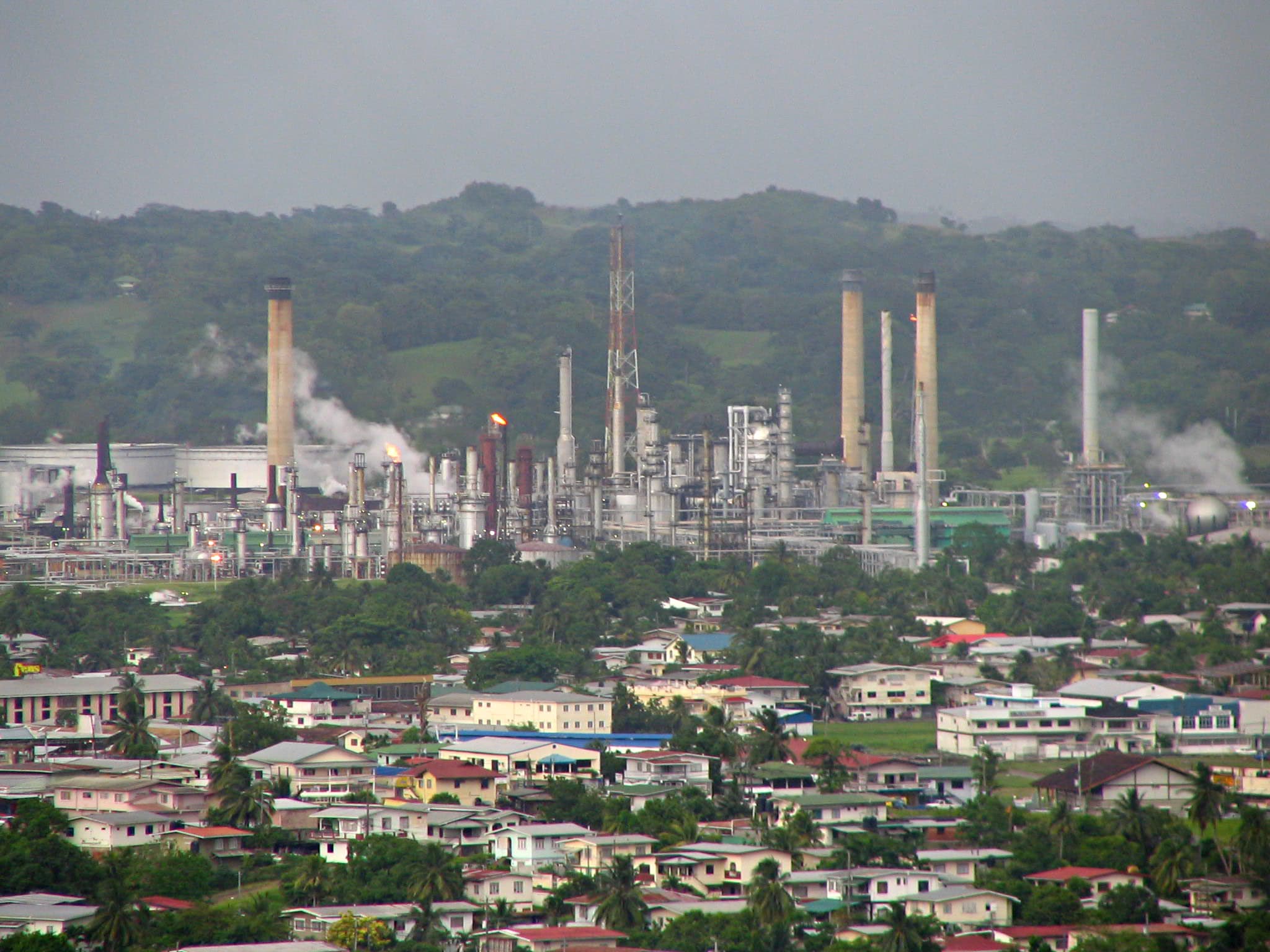
Trinidad and Tobago's natural gas production averaged 2.537 billion cubic feet per day in 2024, according to the Ministry of Energy and Energy Industries. That figure is down more than 40 percent from the 4.3 bcf/d peak recorded in the mid-2010s. In June 2024, output dipped below 2 bcf/d for the first time in 22 years. It recovered to 2.69 bcf/d by August, but the trajectory remains unmistakable - the country's mature offshore fields are depleting faster than new supply can replace them.
Four companies - bpTT, Shell, EOG Resources, and Woodside - produce roughly 95 percent of the nation's gas. Of these, bpTT is the largest, averaging 1,174 million standard cubic feet per day in 2024. When production falters at any single operator, the national output graph moves with it.
The Energy Chamber's Q1 2026 survey made the downstream picture equally clear. Sixty percent of energy services companies reported lower business value compared to the prior quarter. Fifty-six percent reported below-typical volume. The sector that accounts for about 40 percent of GDP, roughly 80 percent of exports, and approximately 20 percent of direct government revenue is shrinking in real terms.
Every major upstream project that could reverse this decline points to the same year: 2027.
The Convergence
bpTT's Ginger development, sanctioned in 2024, will become the company's fourth subsea project. It involves four subsea wells tied back to the existing Mahogany B platform. Drilling began in late 2025 and continues through this year. At peak, Ginger is expected to produce about 62,000 barrels of oil equivalent per day. First gas is targeted for 2027.
The Coconut gas field - a joint venture between bpTT and EOG Resources, discovered in 2005 in the Columbus Basin at 260 feet of water depth - received its final investment decision and is also targeting 2027 first gas. The two companies have recent form together. Their Mento platform, fabricated at the TOFCO yard in La Brea, achieved first gas in May 2025, a successful precedent that both partners are hoping to replicate with Coconut.
Shell's Manatee project is the largest single development in the pipeline. The company took FID in July 2024 on the 2.7 trillion cubic feet field in the East Coast Marine Area. The development plan calls for a Normally Unattended Installation platform, eight development wells, and a 110-kilometre subsea pipeline connecting to Shell's onshore Beachfield gas processing facility, which feeds both Atlantic LNG and the National Gas Company's domestic network. At peak, Manatee is expected to produce approximately 604 million standard cubic feet per day - a transformative volume that could, on its own, offset several years of decline. Shell targets first production in 2027.
Then there is Dragon. The cross-border field straddling Venezuelan waters contains an estimated four trillion cubic feet of gas. Venezuela granted a 30-year licence to Shell and NGC in 2023. The development plan envisions a 17-kilometre subsea tie-back to Trinidad and Tobago's existing infrastructure, with first-phase production of roughly 185 million cubic feet per day. But Dragon has been discussed for over 40 years, and the project's fortunes rise and fall with the geopolitics of the day.
Who Built the Pipeline
Every project in the 2027 convergence was sanctioned under the PNM government that left office in May 2025. Manatee, Ginger, Coconut, Cypre - each received its Final Investment Decision before the UNC took power. Energy Minister Roodal Moonilal inherited a portfolio already in execution.
Former Energy Minister Stuart Young has been direct about this, stating that there is not a single new initiative Moonilal has conceptualised or is responsible for that has led to any increased oil or gas production since May 2025. The framing is partisan, but the timeline backs the core claim - these projects were conceived, negotiated, and sanctioned on someone else's watch.
Moonilal also faces a $275 million EMBD highway cartel lawsuit, with the trial set for June 2026. Separately, he approved a Heritage Petroleum agreement to TN Ramnauth - his co-defendant in the same EMBD case. Whether or not that approval was improper, an Energy Minister directing state oil company contracts toward a fellow defendant in a fraud case is hard to explain away.
The rigs are drilling regardless of who claims credit in Parliament. But the political context shapes what comes next - and whether the current administration has the focus to negotiate the upstream agreements that will matter in 2030 and beyond.
Dragon's Geopolitical Maze
Following the US military extraction of Venezuelan President Nicolas Maduro in January 2026, Trinidad and Tobago's Foreign Minister acknowledged there was "no certainty" on Dragon. Shell and BP filed new licence requests with the US Treasury's Office of Foreign Assets Control. By February 2026, Washington issued two General Licences for Trinidad and Tobago energy activities in Venezuela, with Secretary of State Rubio expressing support. But the new authorisation came with conditions - mandatory inclusion of US companies in the development and a prohibition on direct cash payments to the Venezuelan government. Royalty payments must now flow to a US-controlled fund.
The OFAC licence history alone illustrates the problem. In April 2025, the Trump administration revoked the original Dragon licence, forcing Shell and BP to wind down operations by late May. Then in October 2025, a new authorisation was granted in three stages, allowing negotiations through April 2026. Shell targets a final investment decision for Q4 2027, with first production to follow - meaning Dragon gas, even under the best scenario, will not flow until well after the other 2027 projects.
As the Kaieteur News put it, Dragon has waited decades not because the gas is difficult to extract, but because political alignment has never held long enough.
Atlantic LNG Under Strain
While the upstream projects inch toward 2027, the country's primary LNG export facility is under acute pressure. Atlantic LNG at Point Fortin has a nameplate capacity of roughly 12 million tonnes per year across four liquefaction trains. In 2025, it produced only 9 million tonnes - a gap driven entirely by insufficient feedstock gas.
In March 2025, BP confirmed that Train 1, the oldest and least efficient of the four units at 3 million tonnes per year of capacity, would be permanently decommissioned and decoupled from the facility. Removal begins in Q4 2026. It is the first permanent decommissioning at Atlantic LNG, and the project's shareholders - Shell, BP, and NGC - determined it made no economic sense to maintain a train that could not be fed.
The situation worsened in February 2026. On February 11, Train 3, which has a capacity of 3 million tonnes per year, was shut down for emergency repairs after a crack was discovered in its flaring system. Repairs were expected to take up to a month. Then Train 4 was scheduled for turnaround maintenance beginning May 4, a 45-to-50-day shutdown that is likely to reduce Atlantic LNG's output by more than 600,000 tonnes.
The math is stark. With Train 1 gone and Trains 3 and 4 cycling through shutdowns, Atlantic LNG's effective output in the first half of 2026 is substantially below even the reduced 9 million tonne pace of 2025. Trinidad and Tobago has spare liquefaction capacity and no gas to fill it.
The Downstream Fracture at Point Lisas
The gas shortage is not limited to LNG. On January 1, 2026, the National Gas Company cut off supply to Nutrien, the Canadian fertiliser producer that had operated at Point Lisas for 45 years. NGC alleged Nutrien owed approximately US$28 million in retroactive port fees. Nutrien denied the claim, stating all its invoices were paid. The company had begun a controlled shutdown of its nitrogen operations in October 2025 after the National Energy Corporation imposed port access restrictions.
Nutrien's Point Lisas operations produced about 85,000 tonnes of ammonia and 55,000 tonnes of urea per month. Over 500 workers now face termination. The shutdown also severed the local CO2 supply chain - critical for medical, food processing, and industrial applications. NGC accused downstream companies of diverting US dollar revenues overseas. Nutrien responded by ending a 45-year relationship with the country.
The Nutrien departure raises the question that other Point Lisas operators - Methanex, Proman, and the remaining producers - are surely asking: what are the terms under which NGC will supply gas going forward, and at what price? Gas contract expiry dates across these companies are not publicly compiled. But as Nutrien demonstrated, a contract dispute can shutter a major facility overnight, with cascading consequences.
The Paradox of High Prices
The escalation of the Middle East conflict on February 28, which disrupted approximately 20 percent of global LNG supply through the Strait of Hormuz, created a price environment that should have been enormously beneficial for Trinidad and Tobago. The European gas benchmark TTF surged roughly 48 percent. Urea prices jumped from US$482 to US$720 per tonne. Ammonia moved from US$495 to US$600.
These prices reward production increases at exactly the moment production is falling. The petrochemical sector, which should be capturing the windfall, is operating below capacity. Nutrien is shut down. Atlantic LNG lost a significant share of its output to emergency repairs and maintenance. The country is sitting next to a fire sale with an empty wallet.
The Bridge Year Economy
The fiscal 2026 budget was built on energy price assumptions of US$73.25 per barrel for oil and US$4.35 per MMBtu for gas. Total projected revenue of TT$55.4 billion includes TT$11.3 billion from oil - roughly 20 percent of the total. Expected expenditure of TT$59.2 billion implies a deficit of approximately TT$3.8 billion, which the government projects at under 3 percent of GDP. The IMF, however, estimated the central government deficit at 5.0 percent of GDP for fiscal 2026, an improvement from 5.9 percent in fiscal 2024 but still substantial.
The US$1 billion sovereign bond issued in late 2025 provided a fiscal cushion, but that injection flatters the reserve position. Moody's reported a 24 percent decline in liquid forex reserves over one year to US$3.2 billion as of August 2025. The January 2026 recovery to US$5.58 billion includes the bond proceeds - strip that out and the underlying trend is deterioration. The IMF recommended a more flexible exchange rate and higher interest rates. The Central Bank's repo rate has sat at 3.5 percent since March 2020, even as the US-Trinidad and Tobago interest rate differential has turned negative.
The IMF's 2026 Article IV mission, which visited the country in late January and early February, projected real GDP growth of just 1.2 percent for 2026. Staff emphasised the importance of balancing energy-sector dependence with conditions that promote non-energy growth - a polite way of saying the country cannot continue betting everything on gas.
What Should Be Watched
The contract expiry dates across downstream operators at Point Lisas remain opaque. These contracts determine how much gas stays in Trinidad and Tobago and at what price. As Nutrien's experience shows, the terms matter as much as the volume.
The "bridge year" revenue gap - the difference between what the budget assumed and what Q1 energy sector performance suggests the government will actually collect - has not been calculated publicly. This gap determines how much of the sovereign bond will be consumed by fiscal 2026 and how much remains as a buffer.
The question of whether Guyana's offshore gas could eventually flow to Trinidad and Tobago for processing, reviving underutilised LNG infrastructure, has been discussed at the political level. Vice President Jagdeo raised the possibility of exporting Guyanese gas to Trinidad and Tobago. It remains speculative, but it represents the only medium-term alternative to the 2027 upstream convergence that does not depend entirely on projects already in motion.
The projects are real. The operators are committed. bpTT, Shell, and EOG Resources have spent billions on Ginger, Manatee, and Coconut. Drilling rigs are in the water. Platforms are under construction. But offshore developments routinely slip. Subsea installations encounter weather, equipment, and commissioning delays. A project that targets first gas in Q3 2027 can easily become Q1 2028 without anyone having made a mistake - the timeline simply stretches under the weight of complexity.
If most of these projects deliver on schedule, 2027 marks a genuine inflection. Gas production recovers toward the government's 3.2 bcf/d target. Atlantic LNG fills its remaining trains. Revenue rises. Reserves stabilise.
If they do not - if one or two slip by even a year - then the bridge year becomes two bridge years, and the fiscal position deteriorates further into the territory the IMF is warning about. The country is running on fumes. Everything depends on what arrives next year.
Sources
- Ministry of Energy and Energy Industries: 2024 Natural Gas Production Data
- OilNOW: "Trinidad's 2024 gas output averages 2.537 bscf/d" (2025)
- Energy Chamber of Trinidad and Tobago: Q1 2026 Survey
- Trinidad Guardian: "Energy sector optimistic about 2026" (January 27, 2026)
- Trinidad Guardian: "Energy services companies report decline in business in Q1 2026"
- Trinidad Express: "BP and Shell gear up for 2027 production surge in T&T"
- BP Trinidad and Tobago: Ginger Project Page
- BP Trinidad and Tobago: Coconut Joint Venture Sanction Announcement
- BP Trinidad and Tobago: Mento First Gas Announcement (May 2025)
- World Oil: "Shell to grow LNG business with 2027 Manatee natural gas production start-up offshore Trinidad and Tobago" (July 2024)
- Oil & Gas Journal: "Shell takes FID on 2.7-tcf Manatee gas field off Trinidad and Tobago"
- S&P Global Commodity Insights: "Green light for Manatee"
- Pipeline & Gas Journal: "Trinidad's Atlantic LNG Plans Q4 Decommissioning of Train 1" (January 2026)
- Pipeline & Gas Journal: "Atlantic LNG Shuts 3 MMtpy Train 3 for Emergency Repairs in Trinidad" (February 2026)
- Pipeline & Gas Journal: "Trinidad's Atlantic LNG Plans 50-Day Shutdown of Train 4" (February 2026)
- Trinidad Express: "BP confirms plans to decommission Train 1"
- Trinidad Guardian: "NGC pulls plug on Nutrien" (January 2026)
- Nutrien Press Release: "Nutrien Commences a Controlled Shut Down of Its Trinidad Nitrogen Operations" (October 2025)
- Global Energy Monitor: Dragon Gas Pipeline Profile
- Jamaica Observer: "Trinidad gets licences from United States for oil and gas activities in Venezuela" (February 2026)
- Caribbean Council: "US cancels gas licences for Trinidad-Venezuela projects"
- Kaieteur News: Dragon Gas Analysis
- IMF: Staff Concluding Statement of the 2026 Article IV Mission (February 10, 2026)
- EY Trinidad: Focus on Trinidad & Tobago Budget 2026
- Ministry of Finance: Budget Statement FY 2026
- Moody's: Trinidad and Tobago Outlook Revision
- OilPrice.com: "Can Trinidad and Tobago Escape the Oil Trap?"
- PwC Trinidad: Trinidad and Tobago Energy Sector Update (October 2024)
- Caribbean Council: "Trinidad and Tobago set for 2027 gas production surge"
- Trinidad Express: Stuart Young parliamentary statements on energy project attribution (2025-2026)
- High Court of Trinidad and Tobago: EMBD highway cartel lawsuit filings
- Trinidad Guardian: "Moonilal approves Heritage Petroleum agreement to Ramnauth" (2025)