On December 17, 2025, Trinidad and Tobago became the first CARICOM state to enact castle doctrine legislation. The Home Invasion Act removes the duty to retreat inside one's dwelling and permits the use of deadly force based on an "honestly held belief" that such force is necessary to protect life. Home invasion itself now carries penalties of 20 years for a first offence and 25 for a subsequent one.
The law addresses something real. Break-ins, home invasions, and the fear that accompanies them are not abstract concerns for Trinbagonians. Violent crime has pushed many citizens to the conclusion that the state cannot protect them inside their own homes. Castle doctrine - the principle that a person's home is the last place they should be forced to retreat from - has a long legal tradition and a straightforward moral logic. If someone breaks into your house at night, the law should not require you to calculate whether you can safely flee before defending yourself.
None of that is controversial. What deserves scrutiny is how the legislation was introduced, who was consulted, and who showed up to sell it.
Consultations in Friendly Territory
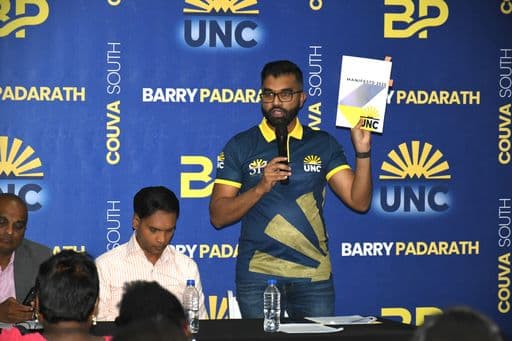
Before the Home Invasion Act reached the floor, the UNC government held a series of public consultations. The locations: Barataria, Fyzabad, Tunapuna, Couva South, and Sangre Grande. All five are UNC-held constituencies or areas with strong UNC support.
No consultations were scheduled in PNM-held communities - not in Diego Martin, not in Laventille, not in Tobago. Nowhere the bill might have faced harder questioning from residents whose experience of crime and policing looks different from the audiences the UNC chose.
This was not accidental. Former Attorney General Garvin Nicholas called for "a more national approach." Minister Saddam Hosein told the PNM to hold its own consultations. The message was plain enough: this is our bill, these are our communities, and if you want outreach elsewhere, do it yourself.
A law that permits citizens to use deadly force affects every citizen of Trinidad and Tobago, regardless of which party they voted for. Running the consultations exclusively through friendly constituencies is not illegal. But it shapes what feedback reaches lawmakers. People who agree with a policy show up. People with doubts tend to stay away, especially when the venue is not their turf.
What Was Said at the Meetings
The consultations produced rhetoric that went well beyond the legal text.
At the Sangre Grande session, attorney Wayne Sturge told attendees: "You could shoot him in the back and explain yourself after." He invoked the late Justice Herbert Volney's famous line - "Better to be judged by twelve than carried by six." The crowd responded warmly. Sturge's reading of the law was generous, to put it mildly. The Act permits deadly force based on an honestly held belief of threat to life. Shooting a fleeing intruder in the back, then explaining yourself after, is not what the statute says. But it is what some people heard the statute say, at a government-endorsed consultation.
This matters because the gap between what the law permits and what citizens believe it permits is where tragedies happen. If Trinbagonians walk away from consultations believing they have blanket authority to shoot anyone who enters their home - regardless of whether that person poses an immediate lethal threat - the law has already been misunderstood before it is ever applied. And misapplication, once a person is dead, cannot be corrected.
The Former AG in the Room
The Fyzabad consultation featured Anand Ramlogan - former Attorney General, former target of corruption charges discontinued in October 2022 in connection with a kickback scheme involving over TT$1 billion in legal fees.
Ramlogan held no government position. He was not billed as a consultant or official representative. He simply showed up, took the microphone, and defended the legislation. Nobody on stage questioned his presence.
When audience members raised concerns about racial bias in policing - whether the law might be applied differently depending on who the homeowner was and who the intruder was - Ramlogan dismissed it as "ridiculous" and "stupid talk." He did not engage with the substance of the question. He offered ridicule instead of evidence.
The question was not unreasonable. In the United States, where stand your ground laws have been studied extensively, the racial disparity evidence is hard to dismiss. The Urban Institute found that shootings involving a white shooter and a Black victim were ruled justifiable 354 percent more often than the reverse in states with stand your ground statutes. RAND research links stand your ground laws to increases in homicides. A JAMA study estimated an 8 to 11 percent increase in firearm homicides in states that adopted them.
Those figures come from the American context, which differs from Trinidad and Tobago in important ways. The Home Invasion Act is castle doctrine - limited to one's dwelling - not full stand your ground in the Florida sense, which extends to any public place. Castle doctrine is narrower and less likely to produce the worst outcomes seen in American jurisdictions.
But the question of disparate application does not vanish because the law is narrower. Trinidad and Tobago has its own history of selective enforcement and its own racial and class dynamics in policing. Dismissing those concerns as stupid rather than engaging with them does not build public confidence in the law. It tells the audience that the question itself is beneath consideration.
The Vote
The Home Invasion Act passed the House of Representatives by a vote of 23 to 10. Twenty-one UNC members and two TPP members voted in favour. Ten PNM members voted against. The Independent Senate had not reviewed the bill at the time of the House vote.
A 23-to-10 margin is decisive but not bipartisan. The bill passed because the government has the numbers, not because it built consensus. That is the government's prerogative under the Westminster system. But legislation that authorises deadly force by private citizens - legislation that will inevitably produce cases where someone dies and a court must determine whether the killing was justified - deserves more than a party-line vote preceded by party-line consultations.
Two Stories in One Bill
The Home Invasion Act contains two separate stories, and they pull in opposite directions.
The law itself has legitimate foundations. The duty to retreat inside one's own home was always a strange legal requirement - asking a person to calculate escape routes while someone is breaking down their door. Removing that duty and permitting reasonable force based on an honestly held belief of threat is defensible. The penalties - 20 and 25 years for home invasion - are severe but proportionate to a crime that causes lasting psychological damage even when no physical harm occurs. In a country where the SoE cycle has shown that emergency powers do not address the root causes of violent crime, giving citizens clearer authority to defend their homes is a policy choice reasonable people can support.
The process is a different matter. Consultations conducted only in friendly constituencies. Rhetoric that went well beyond the legal text. A former Attorney General whose corruption charges were discontinued showing up to defend the bill and dismiss racial bias concerns with insults. A party-line vote with no meaningful engagement from the opposition or the Independent Senate.
The process matters because it determines how the law will be understood by the people it governs. If the public consultations told citizens they could shoot first and explain later, the courts will eventually have to correct that understanding - after someone has already been shot. Had the consultations been held nationally, with honest presentations of both the law's protections and its limits, the risk of fatal misunderstanding would be lower.
What Comes Next
The Home Invasion Act is now law. How it works in practice will depend on the facts of individual cases - the circumstances of each break-in, whether the DPP prosecutes homeowners who use force, and whether juries convict.
American data, for what it is worth, suggests that castle doctrine laws produce fewer bad outcomes than full stand your ground statutes. The narrower the space in which deadly force is authorised, the clearer the legal boundaries. Trinidad and Tobago chose the narrower version. That was the right call.
But the consultations, the rhetoric, and the former AG in the room all point to a government more interested in selling the bill than preparing the public to live under it. A law that permits you to kill someone inside your home deserved a careful, inclusive, and honest national conversation. What Trinbagonians got were five meetings in five friendly constituencies, a lawyer telling them to shoot first and explain later, and a former AG calling racial bias concerns stupid.
The law may be sound. The process that produced it was not. When the first disputed shooting under the Home Invasion Act reaches a courtroom - and it will - the gap between what the law says and what citizens were told it says will be the thing that matters most. The accountability ledger documents the broader pattern of governance failures across both parties.
Sources
- Parliament of Trinidad and Tobago: Home Invasion Act, 2025 (signed December 17, 2025)
- Hansard: House of Representatives debate and division, Home Invasion Act (23-10 vote)
- Trinidad Express: "Home Invasion Bill passes in House" (December 2025)
- Newsday: Editorial - "Vigilantism dressed as legislation" (December 2025)
- Newsday: "Nicholas calls for national approach to consultations" (November 2025)
- Trinidad Guardian: "Wayne Sturge at Sangre Grande consultation" (November 2025)
- Trinidad Guardian: "Ramlogan defends Home Invasion Bill at Fyzabad" (November 2025)
- Trinidad Express: "Ramlogan, Ramdeen charges discontinued" (October 2022)
- RAND Corporation: "The Effects of Stand-Your-Ground Laws" (2020)
- JAMA Internal Medicine: "Firearm Homicide Incidence and Stand Your Ground Laws" (2022)
- Urban Institute: "Racial Disparities in Stand Your Ground Laws" (2013)
- CNC3: "Public consultations on Home Invasion Bill" (November 2025)
- Newsday: "Ramdial: PNM free to hold own consultations" (November 2025)